Greenely · 2025 · Design · Supporting
Onboarding — reducing cognitive load for battery features
A playful, informative onboarding path that introduces battery features without overwhelming new users — progressive disclosure for a dense energy product.
- Onboarding
- UX Writing
- Cognitive load
- Mobile
- Role
- Product Designer — UX/UI
- Team
- Greenely product & design
- Timeline
- Feature onboarding design
- Platform
- Mobile app
Brief
What a recruiter should know in 30 seconds
What I did
Designed an onboarding path using progressive disclosure for battery feature discovery.
What changed
Sequenced education around first successful action instead of a comprehensive feature tour.
How we knew
Intended for activation/funnel validation after release — public metrics not available.
Insight → decision
Evidence that changed the design
Insight
Front-loading the full battery mental model increased drop risk.
Decision
One idea per step, tied to a nearby action.
Insight
Playfulness helped memory only when it didn’t compete with instructional precision.
Decision
Kept tone informative first; delight second.
Visuals
Artifact
01
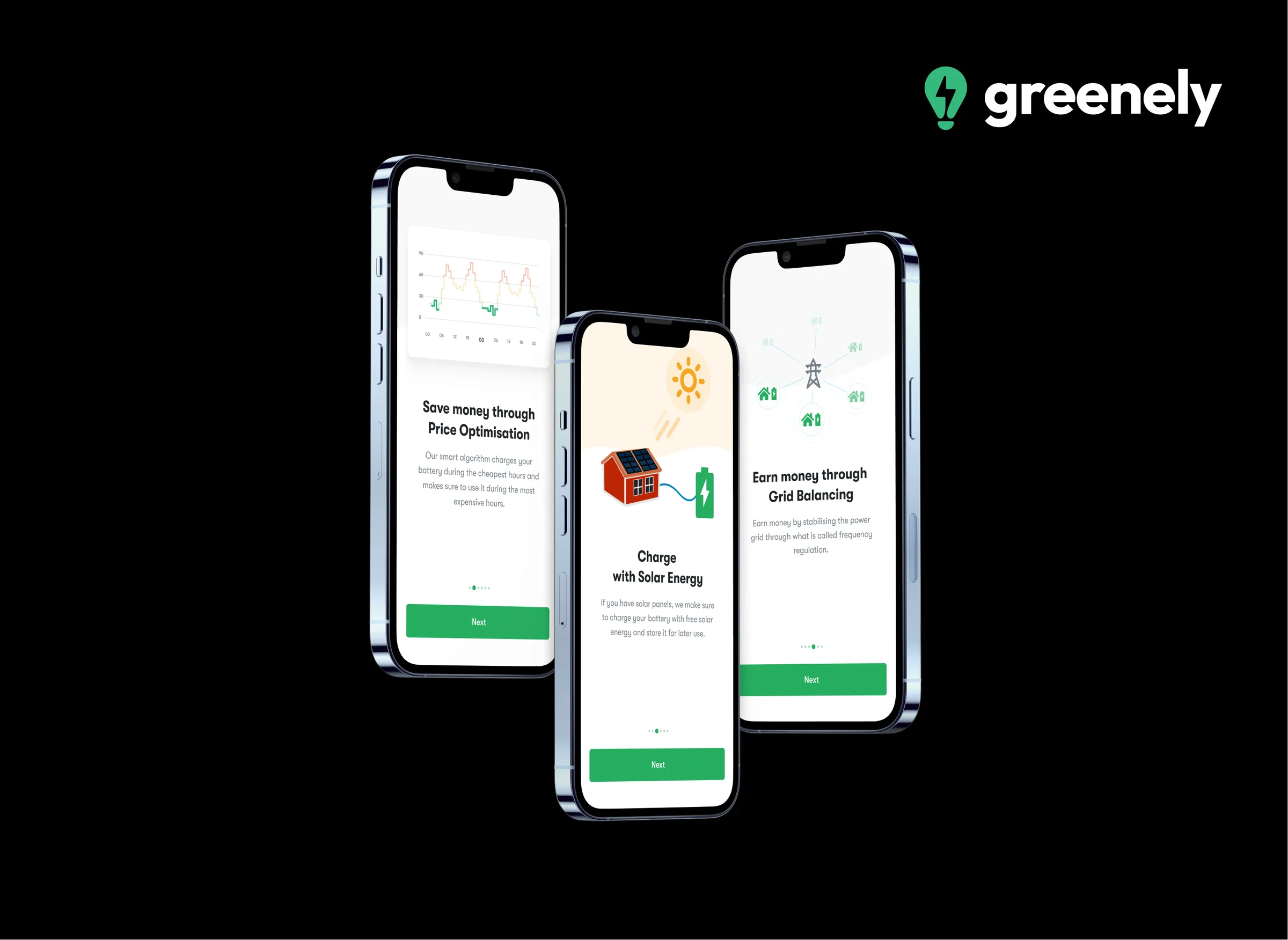
Onboarding frames — one idea at a time toward first success
Secondary proof: activation design, not a full research case.
- One idea per step
- Teach beside the next action
- Skip path for users who already know the domain
Approach
Problem, role, and decisions
Problem
First-run and feature-discovery moments risked cognitive overload — too many concepts (battery state, scheduling, history) arriving before users had a reason to care.
What I owned
I designed an onboarding narrative focused on reduced cognitive load — sequencing concepts, calibrating tone, and using progressive disclosure so users meet complexity only when it becomes useful.
Key decisions
Progressive disclosure structure
Matches how users build mental models under limited attention
Playful but precise voice
Supports memory without undermining trust in energy contexts
Accessibility
- Clear reading order and short sentences for cognitive accessibility
- Meaningful text alternatives for illustrative frames — [Add final alt text set here]
- Respect reduced-motion preferences for any animated explanations
- Ensure skip controls are keyboard reachable
Results
Outcome
Design outcome
Onboarding path oriented around reduced cognitive load and progressive disclosure
Activation metrics
[Add measurable outcome here]
Reflection
- Lesson
- Onboarding success is measured by the first confident action.
- What I would improve
- I would instrument each step with drop-off analytics and run a copy A/B on the scheduling introduction specifically.